Overview
Almost 2,000 tons of food waste. One 10-week sprint. A 15% carbon footprint reduction.
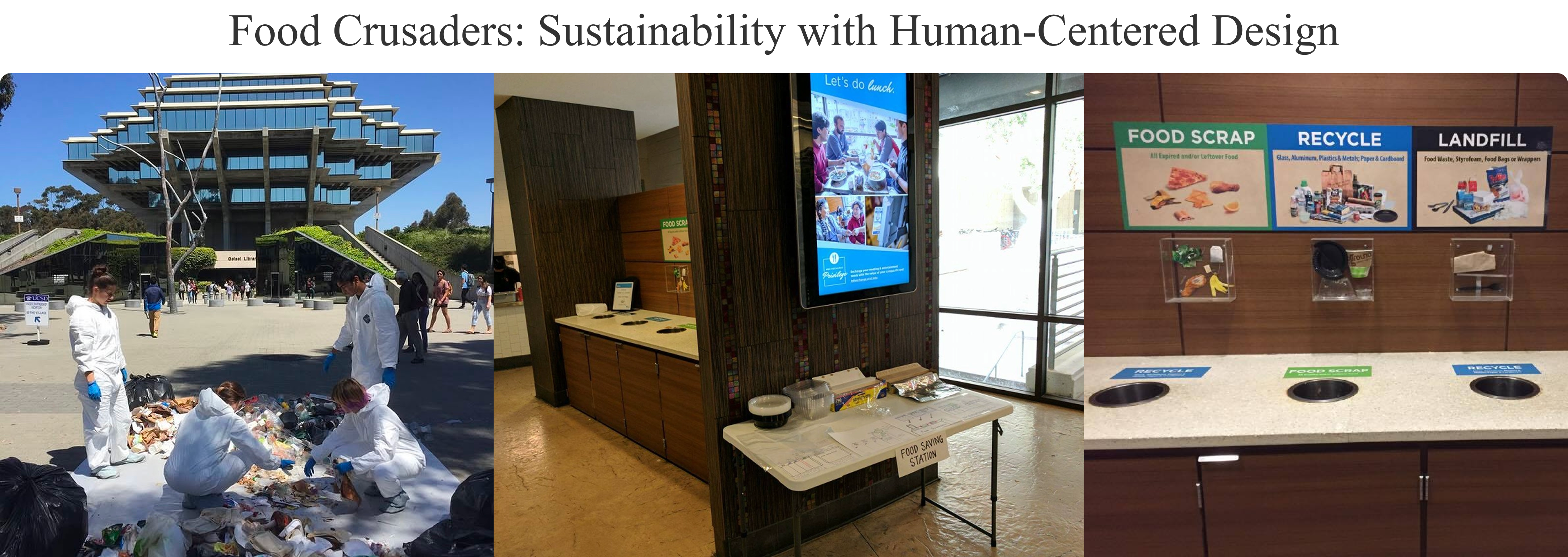
I spearheaded a cross-functional team, The Food Crusaders, to help the university transform dining halls into sustainable ecosystems with data-driven behavioral design. I supervised everyone through all phases of product development— from fieldwork inside UCSD's busiest dining hall to presenting our findings to 130+ stakeholders. Using a mixed-methods approach, I uncovered detailed insights about why students waste food and designed a system that works with their behavior instead of against it.
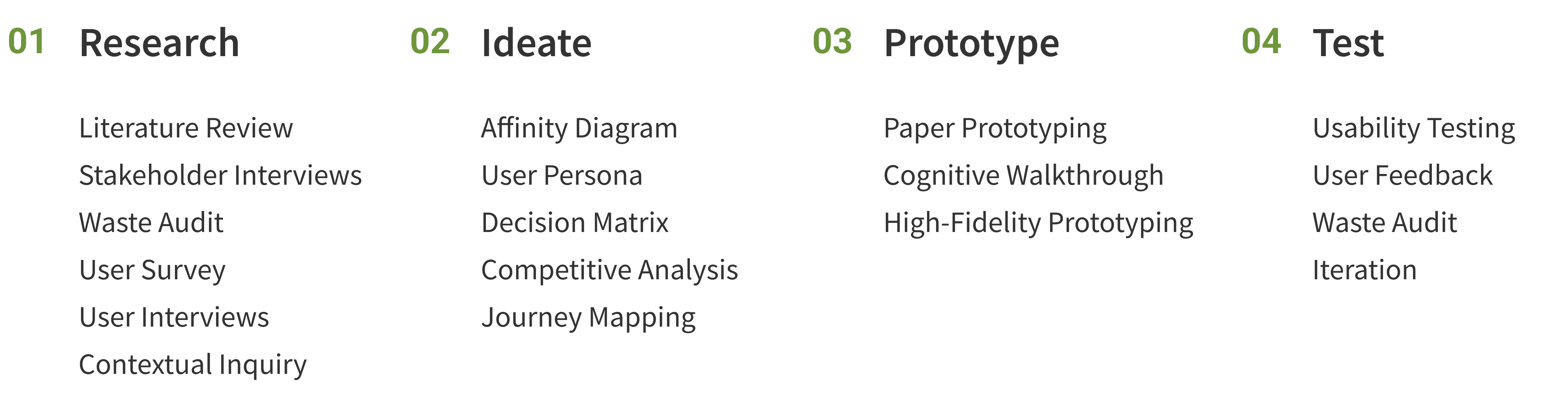
Our Process
The Problem
Food waste refers to food that is fit for consumption but is discarded anyway. It is the second highest component of landfills. The University of California committed its campuses to achieving zero waste, defined as 90% diversion from landfills, by 2020. Dining halls are contributing over 1,700 tons of food waste annually, yet Housing Dining Hospitality can't move the needle.
The Solution
The Food Crusaders and I quickly realized this problem isn't about a single individual, it's about building a sustainable food ecosystem. A policy that combines systemic interventions and behavioral nudges will be needed to create long-term change. Our solution was to redesign waste disposal practices and create a Food Saving Station with eco-friendly packaging to divert plate waste. We achieved a 15% carbon footprint reduction in campus dining halls.
Role
Design/Research Lead
Team Members
Ibironke Odubela, James Martinez, Christian Pinedo, Alisa Prathnadi
Tools
Qualtrics, NVivo, Miro, Google Workspace (Sheets, Docs, Slides)
Research
Research Plan
How might we transform dining halls into sustainable food ecosystems?
Starting with a literature review, I immediately hit a wall: no existing research focused on college students' food waste — only households and retail spaces. This research gap was the green light for a mixed-methods approach.
A survey would tell me what students do. Interviews would tell me why. Since neither could tell the whole story alone, I chose to combine them. Triangulating the data would make my final conclusions a lot more solid and actionable.
With 3 weeks to work, I structured my research around three questions:
- What variables contribute to college students' tendency to waste food?
- What barriers prevent them from making sustainable choices in a high-traffic dining environment?
- How might we turn campus dining halls into centers of food education?
Stakeholder Interviews
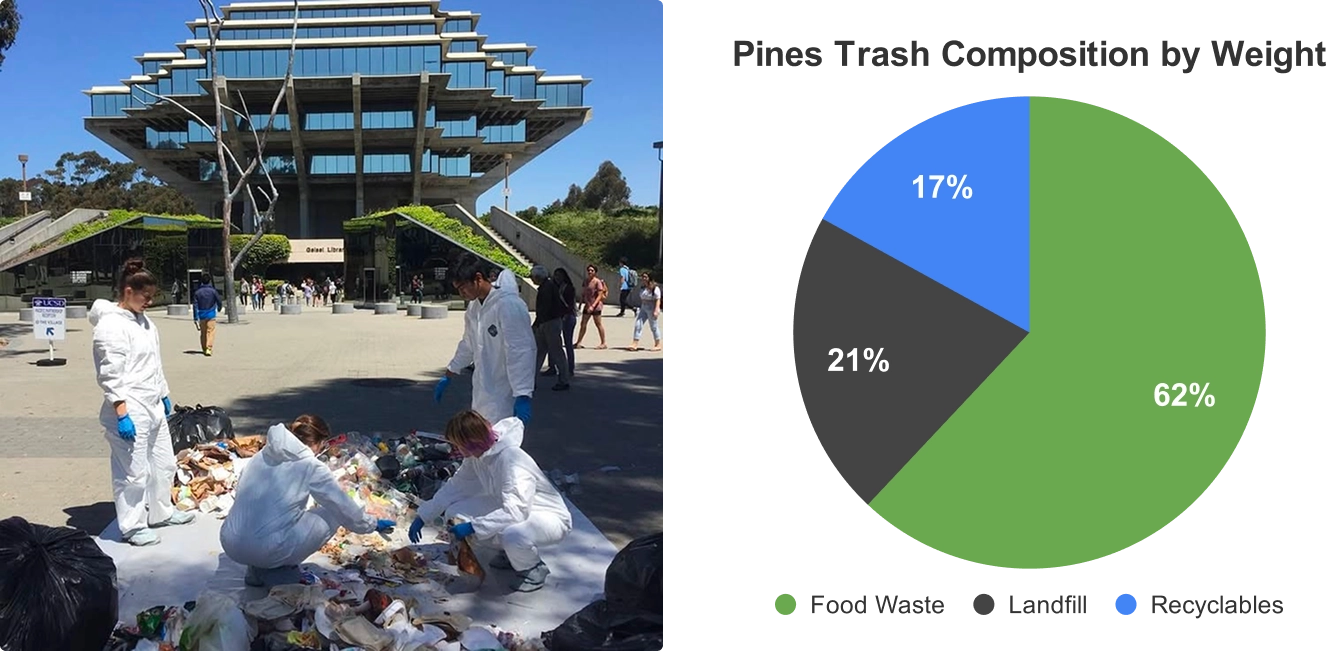
Collaborating with HDH to determine the percentage of recyclables in the trash
We worked closely with Housing Dining Hospitality (HDH) to learn about the Zero Waste Plan and the organization's needs. HDH is responsible for 19 dining locations across campus and has diverted 69% of solid waste from landfills so far, but they'd hit a plateau. The Sustainability Manager explained they prioritize upstream strategies—eliminating waste at the source rather than managing it at the bin.
Our meetings identified a key area for improvement: students contaminating the recycling with trash causes many otherwise recyclable items to end up in the landfill. If paper cups have food residue or plastics are mixed with organic waste, HDH workers have to throw away the entire load. A waste audit revealed that roughly 79% of the waste found in a dining hall could have been recycled or composted. The infrastructure existed but the behavior needed a nudge in the right direction. Getting all the way to zero waste required something HDH couldn't build alone.
User Survey
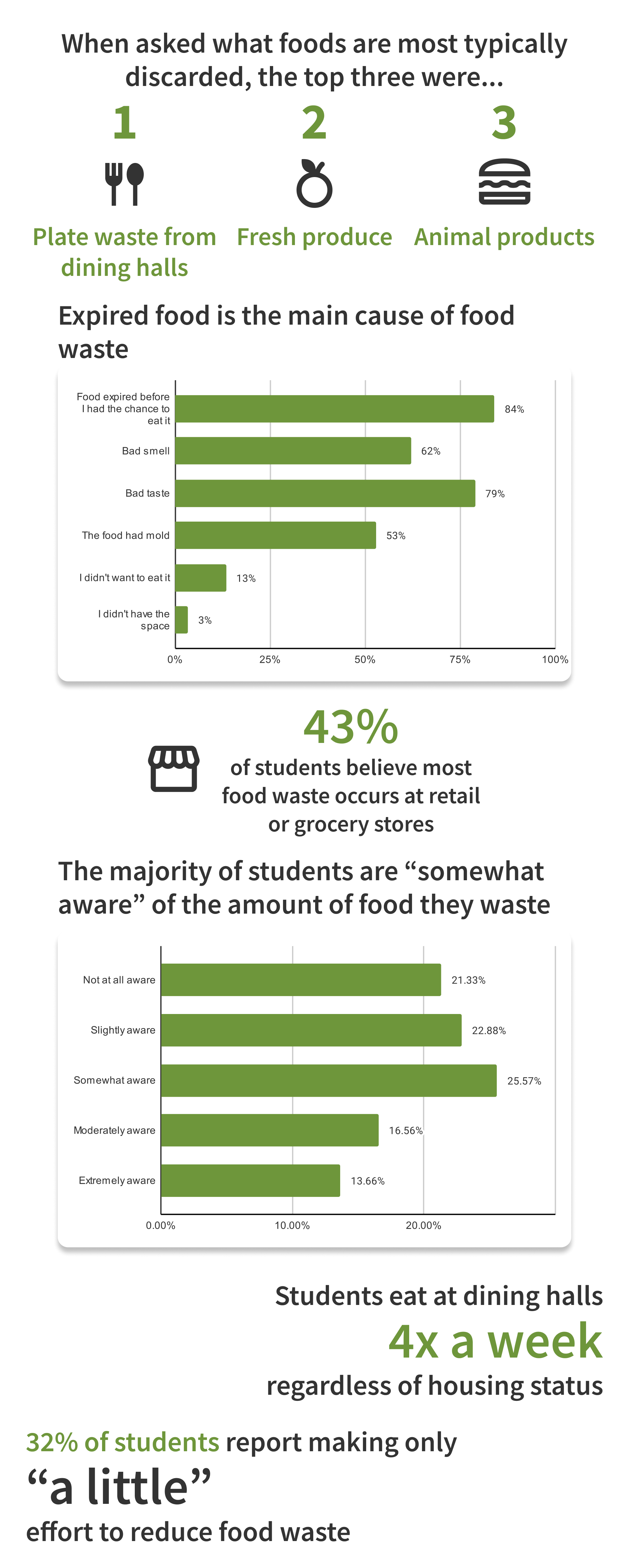
I started with a quantitative survey to map students' eating and waste behaviors before fieldwork. 134 students answered questions on demographics, disposal practices, and attitudes toward food waste. The data from my survey narrowed down the problem space to on-campus dining halls. The results are summarized below:
User Interviews
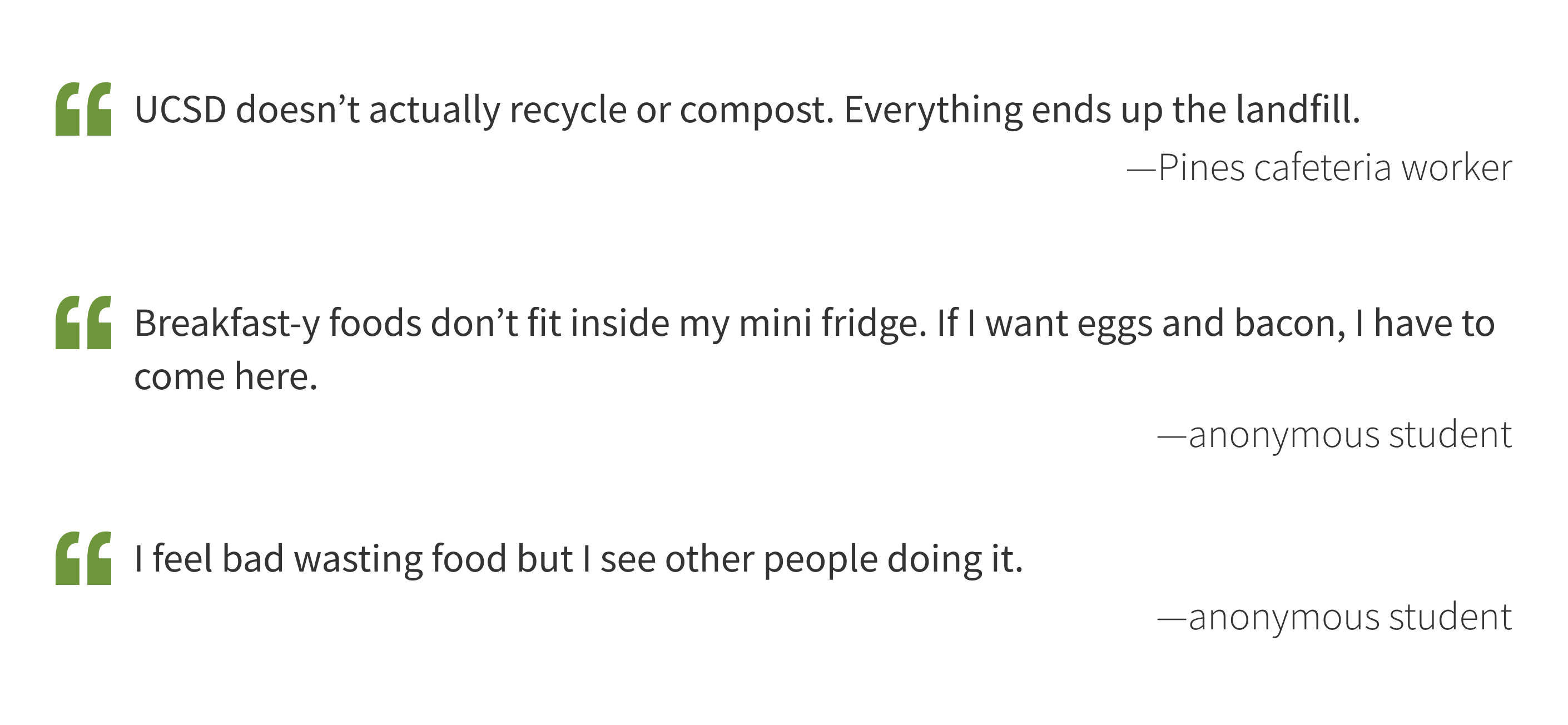
I moved onto 10 in-depth interviews and contextual inquiry inside Pines, the busiest dining hall and ground zero for campus waste. My open-ended questions prompted students to give the "why" behind the waste that couldn't be captured by the survey alone. College students face unique challenges that stop them from going green:
- Mini-Fridge Friction: Students aren't wasteful by choice; they lack the physical storage, forcing a use-it-or-lose-it mentality that freezes out sustainable behaviors.
- Food Management Gap: Mandatory meal plans make home-cooked meals impossible. Since they rely on provided meals, students never develop food management skills. The result: a cycle of chronic over-buying and accidental over-portioning.
- Broken Windows Effect: Students see others tossing half-eaten plates, which destroys all motivation to use sustainable systems.
Ideate
Affinity Diagram
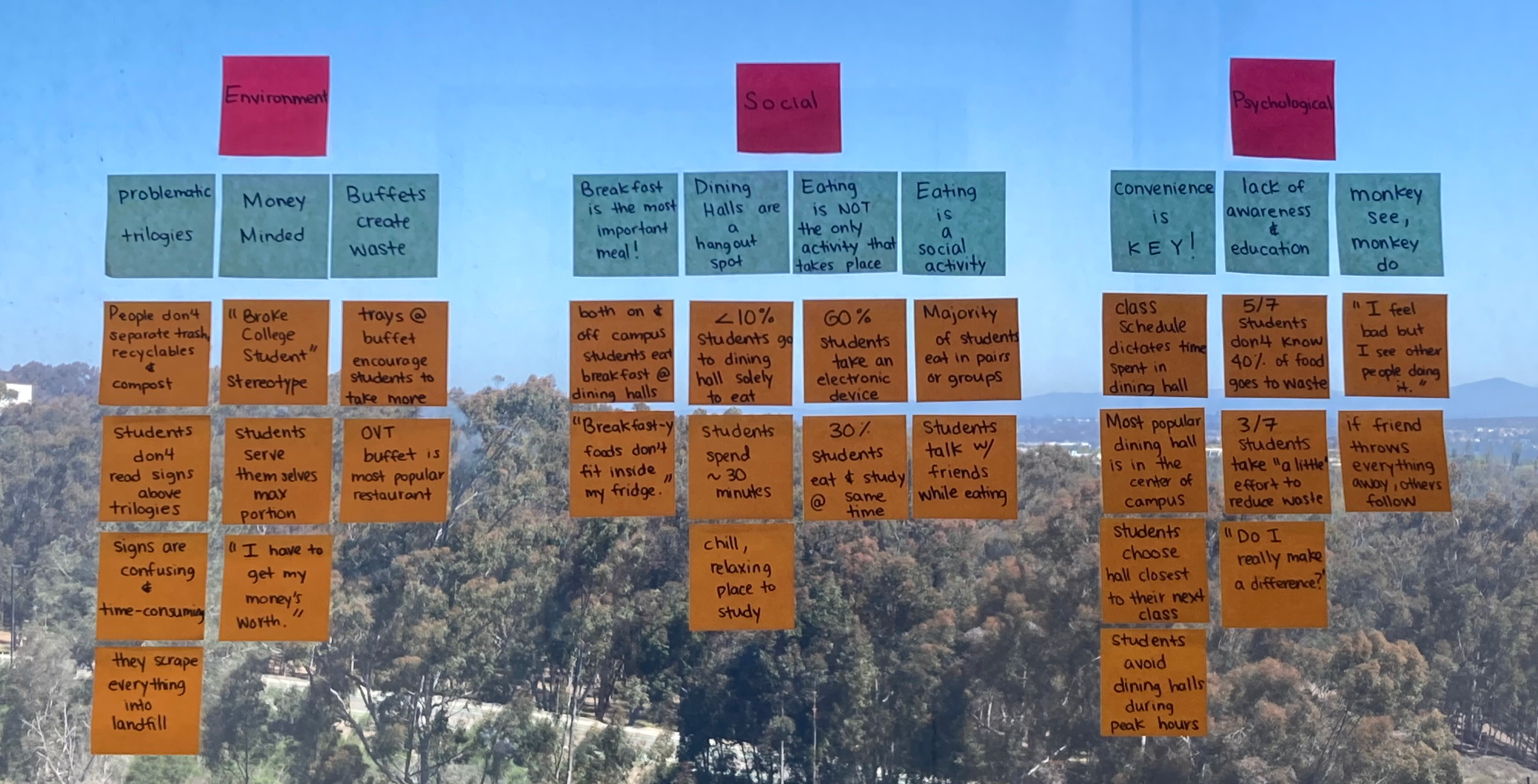
All user insights across surveys and interviews grouped by theme
On Tuesdays, we updated HDH on our progress, asked for feedback, and proposed solutions. On Wednesdays, workshops with The Food Crusaders for rapid brainstorming and design critiques. Keeping both loops running in parallel meant we never lost momentum or stakeholder alignment throughout the 10-week project.
To move from raw observations to a strategic roadmap, we made an affinity diagram. We categorized over 50 insights into three areas: Environment, Social, and Psychological. This was the turning point: we realized the most effective solution lay in transforming food systems not individuals.
User Persona
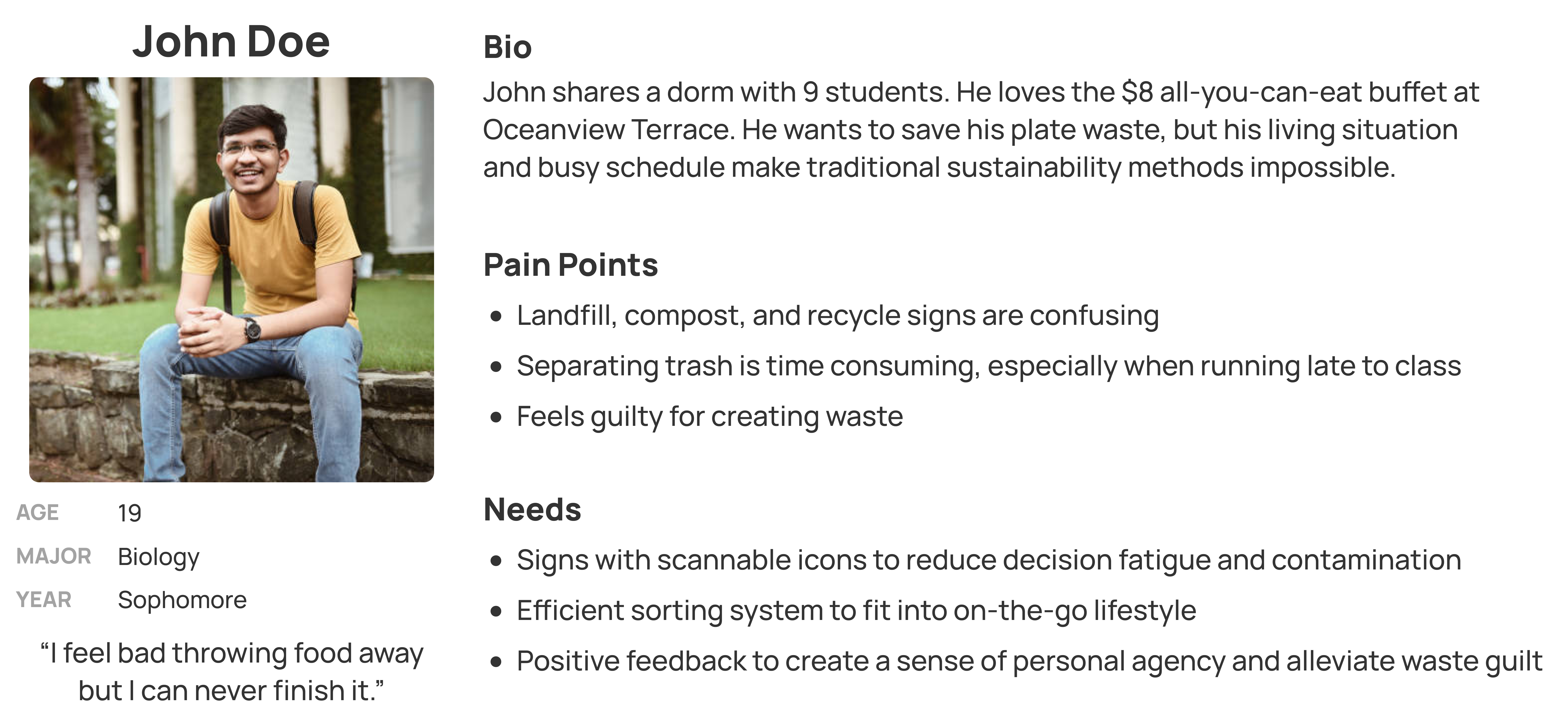
Next we synthesized our data into a user persona to get a better understanding of students' backgrounds, painpoints, and design requirements. Any successful intervention will have to work within students' hectic schedules, tiny fridges, and tight budgets.
The biggest design challenge is student apathy, stemming from a perceived lack of control. Students feel their individual choices don't matter and the system is broken regardless of what they do.
Decision Matrix
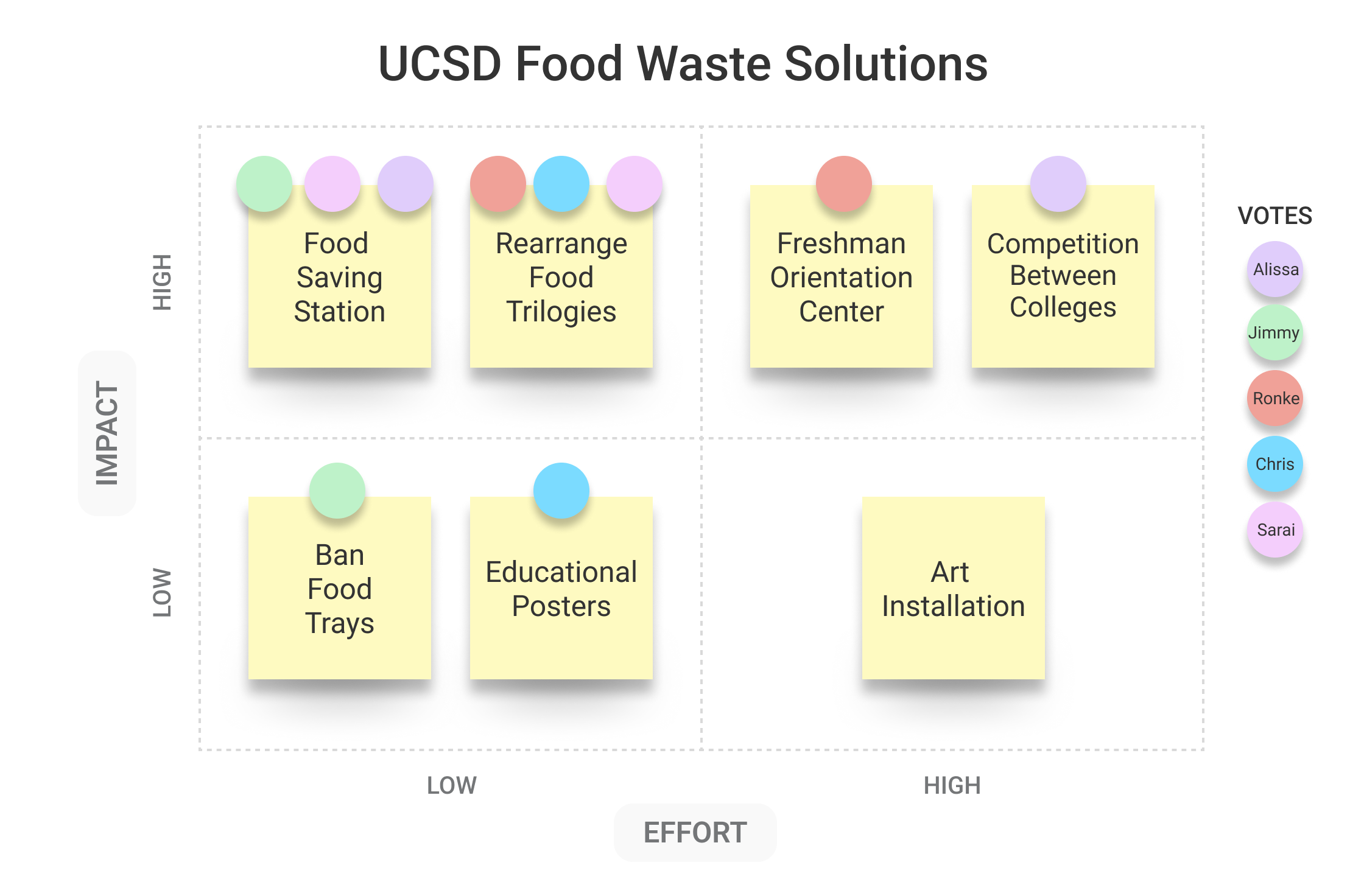
To choose a solution with the highest impact, I led the team in developing a decision matrix where we could rank our ideas. As team leader I made sure everyone's opinion was heard through dot voting. Notably, educational posters and an art installation were voted out. Awareness campaigns don't change behavior. Design does.
We tested our top choices with HDH to ensure they were actually feasible across all 19 dining locations. The verdict: redesign the dining hall trash cans and build a Food Saving Station — high impact, realistic to implement, and scalable across campus.
Prototype
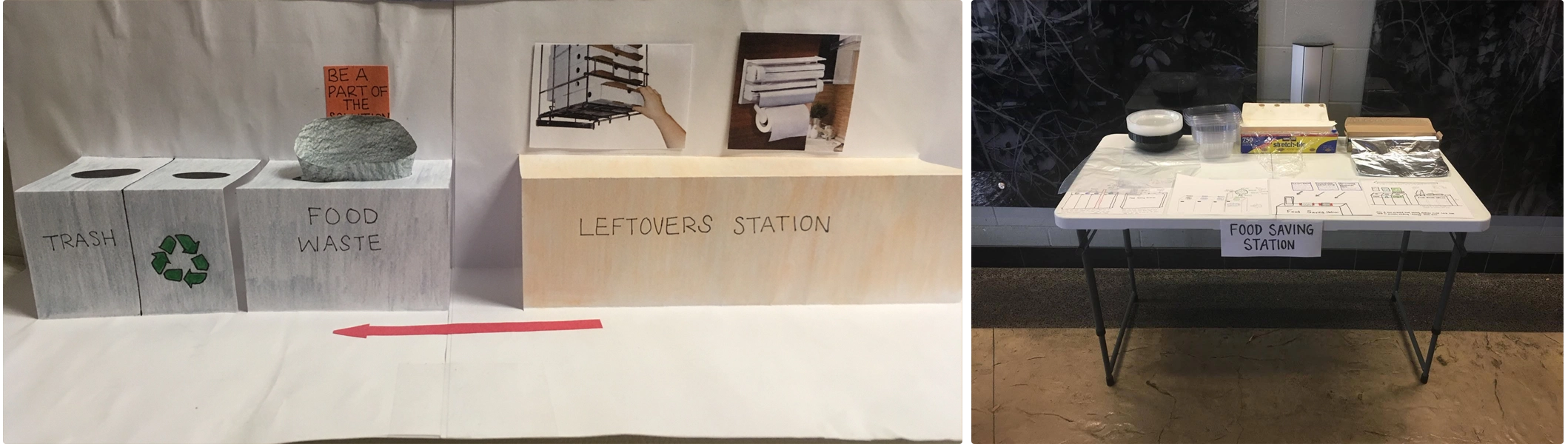
Early prototypes of The Food Crusaders' upstream strategies
Trash cans in dining halls, known as trilogies, have a 3 compartment design with color-coded signs to help people sort waste into landfill, compost, or recycle. The landfill compartment always sits next to the exit, making it the path of least resistance. Students don't sort intentionally—they dump instinctively. Our fix was deceptively simple: move the landfill compartment furthest from the exit. No new infrastructure, no "go green" posters. Just friction in the right place.
The second intervention is a Food Saving Station with reusable or biodegradable take-out containers to rescue food before it enters the waste stream. When framed as a money-saving option, it will align with student incentives. The Food Saving Station should be placed before our redesigned trilogies to work in tandem. Students save what they can then sort what remains. I built a paper prototype to conduct moderated user testing and help stakeholders visualize how our ideas would merge into existing 19 dining locations without a massive infrastructure overhaul.
Test
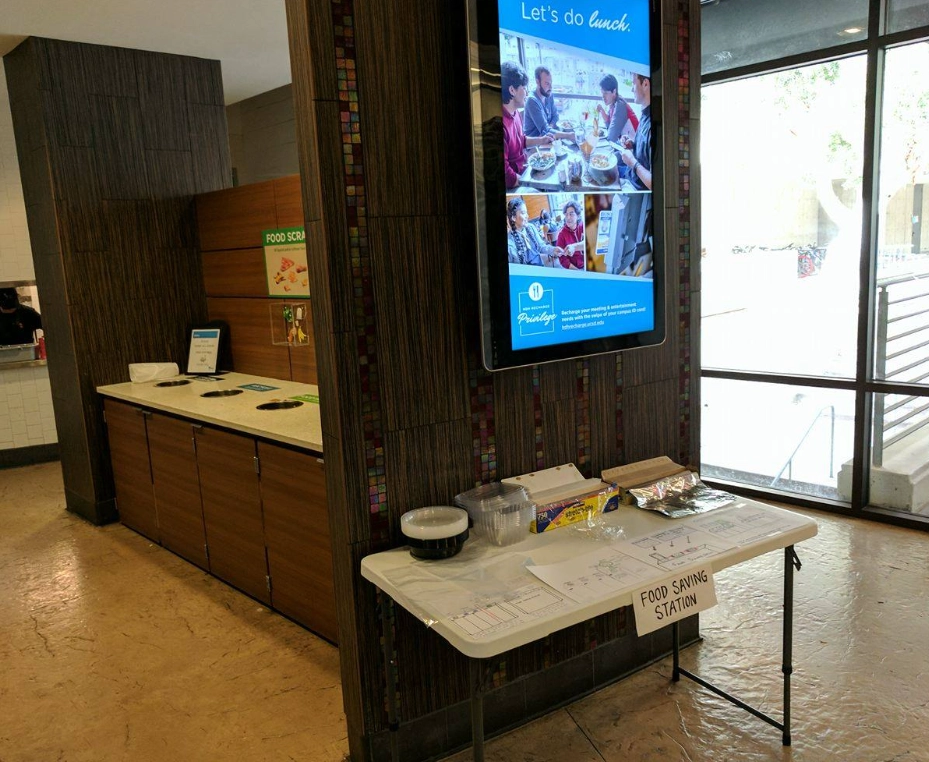
The Food Saving Station and new trilogy inside Pines
We set up the redesigned trilogy and Food Saving Station at Pines and put them to the test. 79% of diners used our Food Saving Station to save their plate waste. A fair criticism was that people might take too many take-out containers because they're free (what we called the Chipotle Effect), creating new waste. We flagged it as a direction for future iteration.
A waste audit proved our trilogy design achieved 15% carbon footprint reduction through increased recycling. We presented our findings and prototypes to an audience of over 130 people, including the Sustainability Resource Center and UCSD Housing Dining Hospitality stakeholders. They were excited by our data-driven approach and encouraged us to apply to their Green Grant!
Lessons Learned

The professor's words of wisdom on the first day of class ended up being The Food Crusaders' motto. Human-centered design is about designing for—not against—natural human behavior. Learning from Don Norman's guest lecture was a defining moment for our project. He said human beings have a bias towards convenience. Instead of trying to change user habits, we seamlessly integrated our solution into their existing routines.
This project also deepened my understanding of effective leadership. Dividing the 10-week roadmap into smaller sprints, holding weekly check-ins, and using dot-voting for consensus, we maintained momentum without burnout. By allowing every team member to weigh in, I ensured an inclusive design process. Great leaders are people who can influence others, help teammates achieve their goals, and let the whole team leverage their own strengths to contribute to the project. We delivered on time, reduced Pines's carbon footprint by 15%, and walked away with a Green Grant invitation. I’m super grateful to the Food Crusaders for this incredible learning experience!